Verbal reasoning
Work with relationships between words, letters or numbers. Look for a rule, make a connection and test whether it fits.
 The Little
WORDS · PATTERNS · SHAPES
A friendly introduction to verbal, non-verbal and spatial reasoning, inspired by the club’s own Instagram puzzle post.
Work with relationships between words, letters or numbers. Look for a rule, make a connection and test whether it fits.
Compare visual information: shapes, shading, position, orientation or repeated details. Explain what stays the same and what changes.
Think about objects and space, such as how a shape might look after being turned or how parts could fit together.
FROM THE CLUB’S NOTEBOOK
The club’s Instagram introduces non-verbal reasoning through 2D and 3D shapes, sequences and odd-one-out puzzles.
A useful approach is to compare one feature at a time. Count the parts, notice the shading, check orientation and look at where details sit. Test an idea against every option.
Explore the original carousel ↗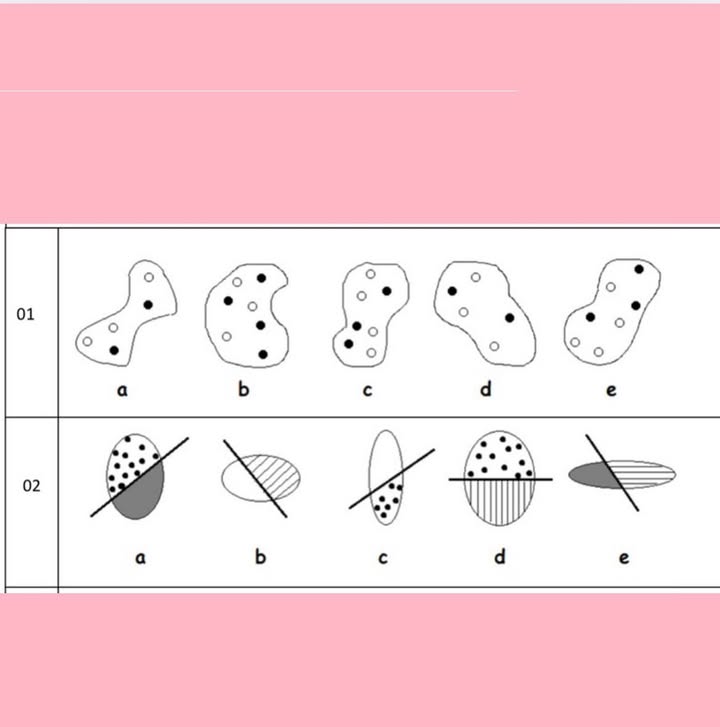
THREE LITTLE CHALLENGES
Bird is to nest as bee is to…
Flower · Hive · Wing
Hive. A nest is a bird’s home; a hive is a bee’s home. A flower is connected with bees, but it does not follow the same relationship.
3, 6, 12, 24, …
What comes next? Describe the rule.
48. Each number is doubled. Check the rule at each step: 3 × 2, 6 × 2, 12 × 2 and 24 × 2.
↑
An arrow points up. Turn it a quarter turn clockwise. Which way does it point?
Right: →. Clockwise follows the direction of the hands on a clock. Try turning a drawn arrow on a piece of paper to check.
These are original introductory activities, not official test questions or a measure of readiness for the 11+.
Sometimes a first idea works for one pair of shapes but not for the whole question. Encourage your child to check the relationship carefully and explain why another option does not fit.
Accuracy and understanding come before speed. When you introduce timing, keep it appropriate to your child and the task, and use the current official materials for the test they plan to take.
Compare Kent, Medway & Bexley routes ↗Interested in 11+ reasoning support? Email Liz to discuss your child’s needs, the right learning focus and current session availability.
A small step. A brighter beginning.
Tell us about your child, their year group and what you’d love them to feel more confident with.